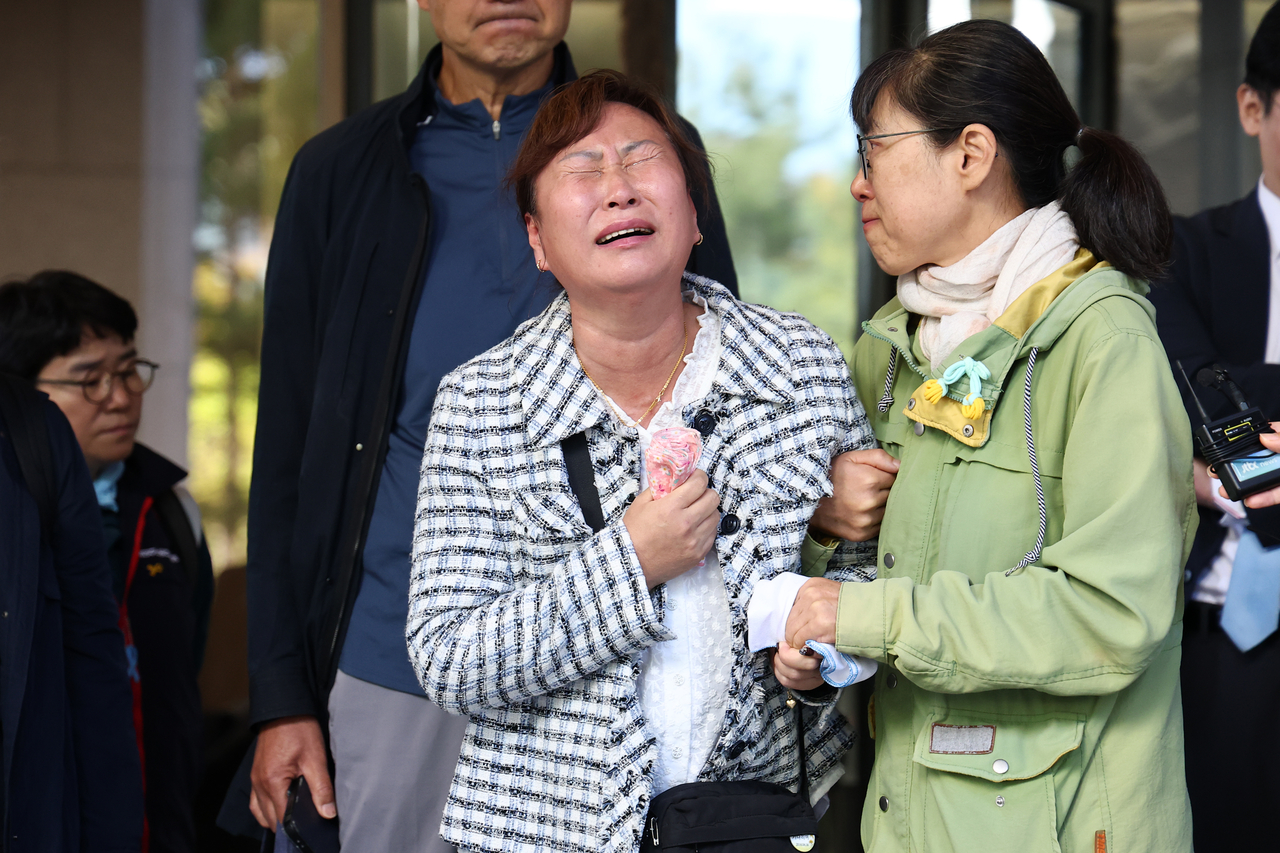
On Tuesday morning, Lee Soon-hee, 56, broke down outside the Supreme Court after it upheld the prison sentence for Aricell CEO Park Soon-kwan over a deadly factory fire in Hwaseong, Gyeonggi Province.
“The victims were all so young. How can they be so cold-blooded?” Lee shouted, leaning on a labor activist. “Are we being treated unfairly because we are foreign nationals? It is so frustrating that my daughter died this way.”
The fire on June 24, 2024, killed 23 workers, including 18 foreign nationals. Lee’s daughter, Eom Jeong-jeong, 25, an ethnic Korean from China, was among them.
The Supreme Court ruling brings the criminal case over the fire to a close, but is unlikely to bring closure for the bereaved families. They are considering a constitutional complaint, while efforts to recover additional remains have yet to be resolved.
Sentences cut on appeal
The Supreme Court upheld a four-year prison sentence for Park Soon-kwan, who was convicted of violating the Serious Accidents Punishment Act, among other offenses.
His son, Park Joong-eon, Aricell’s general manager, received a seven-year prison term and a 1 million won ($753) fine on separate charges, including occupational negligence and violations of the Occupational Safety and Health Act.
Prosecutors accused him of safety lapses involving battery monitoring and storage, worker training, and fire drills. The court also upheld an 800 million won fine for Aricell.
The first-instance court had sentenced both Park Soon-kwan and Park Joong-eon to jail terms of 15 years each.
Those were the heaviest sentences imposed since the Serious Accidents Punishment Act took effect in 2022. An appellate court later reduced the terms to four and seven years, respectively.
Park Soon-kwan was convicted of failing to assess workplace hazards and prepare procedures and manuals to prevent serious accidents. The charges against his son were separate.
The factory’s emergency escape arrangements were a key issue in the appeal. Twenty-one victims were found dead in a packing room on the second floor.
Investigators found a partition made of sandwich panels between the workers and another exit. The first-instance court viewed the blocked escape route as a significant factor in the case.
The appellate court, however, ruled that safety regulations did not require a separate emergency exit on every floor and found no breach of the duty to maintain an exit.
It also cited compensation settlements with the victims’ families as a mitigating factor.
The Supreme Court upheld the appellate court ruling.
Families voice anger over ruling
At a press conference after the ruling, bereaved families and their lawyers questioned whether the Supreme Court had adequately examined the legal basis for the appellate court’s decision. They said the ruling was announced in about 10 seconds, without an explanation in court.
“The court showed too little consideration,” said Yeo Guk-hwa, a relative of Lee Hae-ok, who also died in the fire. “I am sorry that this is all we could do for the 23 people who died. I also feel sorry for the families of industrial accident victims who worked so hard to bring about the Serious Accidents Punishment Act.”
Shin Ha-na, a lawyer representing the families, said the reduced sentences undermined the purpose of the law.
“This case involved the highest death toll in a workplace disaster since the Serious Accidents Punishment Act took effect,” Shin said. “If we find serious errors or distortions in the legal reasoning of the ruling, we will consider filing a constitutional complaint with the Constitutional Court.”
Search for remains unresolved
The families say some remains have yet to be recovered, even though all 23 victims’ funerals had been held by Nov. 3, 2024, 132 days after the fire. They fear that demolishing the damaged site could eliminate any remaining chance of finding them.
The site has deteriorated since the fire, with debris continuing to fall from the structure. Netting has been installed around it, and entry is allowed only after a safety inspection, said Kwon Mi-jeong, a member of a civic group coalition responding to the Aricell disaster.
“As the site is privately owned, the company must cover the cost of the safety inspections. But Aricell has only said it would review the matter, and that has delayed progress,” Kwon said.
Ownership of the site has since been transferred to S-Connect, Aricell’s parent company. Park Soon-kwan resigned as S-Connect’s CEO after the accident.
Gyeonggi Province plans to meet with the company and the bereaved families later this month to discuss recovering additional remains, supporters of the families said.
“The provincial government was slow to act at first,” Song Sung-young, another member of the civic group coalition, said after Tuesday’s news conference. “But S-Connect will need to resolve the issue before it can put the site to use, and it now appears more willing to cooperate. The provincial government also seems to be responding to that change.”
forestjs@heraldcorp.com